



WARNING: SPOILER ALERT
It was the height of the Syrian refugee crisis, and my most conservative friend argued that refugees should be taken in by their own region, certainly not by us. I asked him whether he would feel the same if those refugees looked like him and me. That question stayed with me, and I decided to make a film about a fleeing family with a Northwest European outlook. This premise led, almost immediately, to the end of the Second World War.
The second seed was planted shortly after, when a dangerous politician won a landslide in the Dutch elections. People voted for him because he was funny and eloquent. They mistook charm for character, and handed him their empathy on the strength of a single surface trait.
These two ideas became one film. I wanted to follow a fleeing family, and I wanted the audience to fall into their own empathy trap. Within twenty minutes, I would make them root for a monster. History gave me the figure: a war criminal I could render with full historical accuracy, and build around his one redeeming trait. He was a friend to children.
History has taught us, time and time again, that monsters don’t come dressed as monsters. They come as visionaries, protectors, or loving fathers. By the time we find that truth, it is most often too late. It is happening as we speak.

His debut short Drawback (2024), starring Claes Bang, won 44 international awards. A dialoguefree ode to the visual arts, and a playful rebuke of film convention, it established his register: controlled, unsentimental, and unafraid.
In 2025, Swinkels produced Beyond Silence, directed by Marnie Blok. The film won at Tribeca and Palm Springs and was shortlisted for the 2026 Academy Awards in the Best Live Action Short category. Working on a film about intergenerational trauma shaped his own practice as a director.
Odessa (2026) is his third film and his first shot on 35mm anamorphic. A period piece set in the final days of the Second World War, it turns his interest in moral complicity on the audience itself.
Before film, she worked in high-end international event production - the kind of work that teaches you how to run a crew, hold a budget, and solve problems while the clock is moving.
Odessa is her first film as lead producer, and one of the most logistically demanding shorts a first-time lead producer could choose: 35mm anamorphic, on location in the Dolomites, with an international cast.

Founded in 2016 by Harald Swinkels, Exosphere aims at producing bold, high-quality cinema. The company focuses on intelligent, globally relevant films and series that blend artistic vision with commercial appeal.
With the capacity for large-scale productions, Exosphere stands out among new studios. Swinkels’ success in building a €500 million company brings rare business acumen to his creative leadership. Backed by top industry talent, Exosphere delivers visually striking, thoughtprovoking films for international audiences.
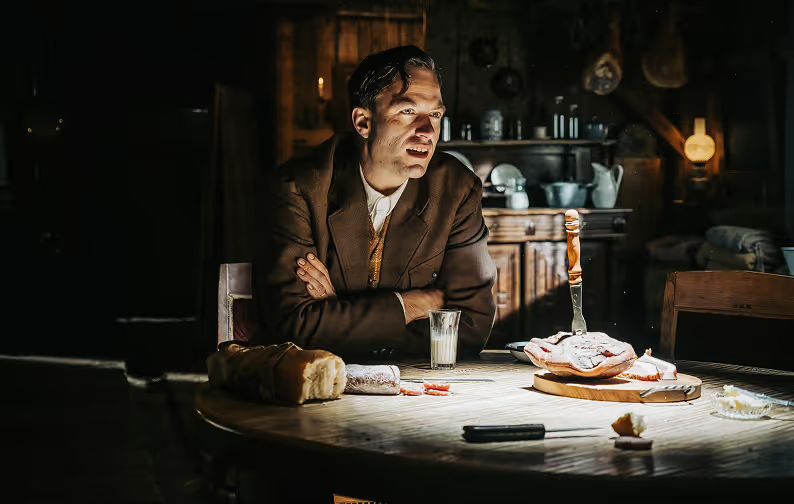
Bastian Beyer was born in Ostercappeln, Germany. After studying acting at the Otto Falckenberg School in Munich, he performed on stages such as the Münchner Kammerspiele, the Vorarlberg State Theatre and the Mainfranken Theatre Würzburg. In addition to numerous theatre and musical roles, including in The Rocky Horror Show and Kabale und Liebe, he can be regularly seen in film and television productions.
Bastian gained international experience with the leading role of cross-country skier Oswald Bartel in the Czech film The Last Race (2022), based on real events that took place in 1913. Further, he has appeared in international co-productions and has worked with directors from various countries. Since 2024, he has played Stefan Wolff in the Sat.1 series Die Spreewaldklinik.
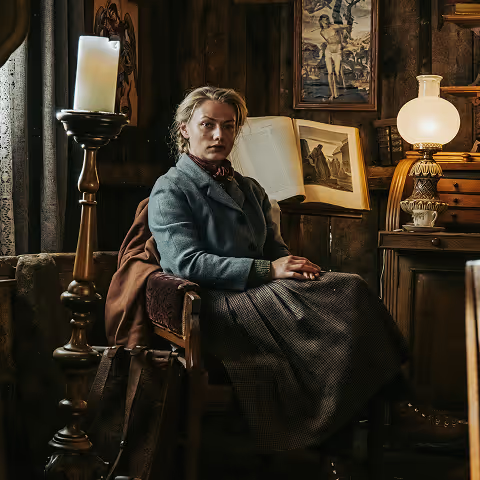
Magdalena Müller was born in Munich and spent her childhood between Germany and Austria. She began her career in local theater and on German television, with early roles in Tatort. After briefly exploring screenwriting, she fully committed to acting, training at the renowned Schauspielschule Zerboni. During her time at Theater Wasserburg, she performed in Leonce und Lena at the Bayerische Theatertage 2020 and starred in Der Olga Korbut Effekt, a one-woman play honoring the 1972 Munich Olympics.
Her television credits include Über Land and Die Rosenheim-Cops. On the film festival circuit, she appeared in Saviour Woman (2018), winner of the Short to the Point Award in Romania, and Elisa, which premiered at the 2024 Internationale Hofer Filmtage.
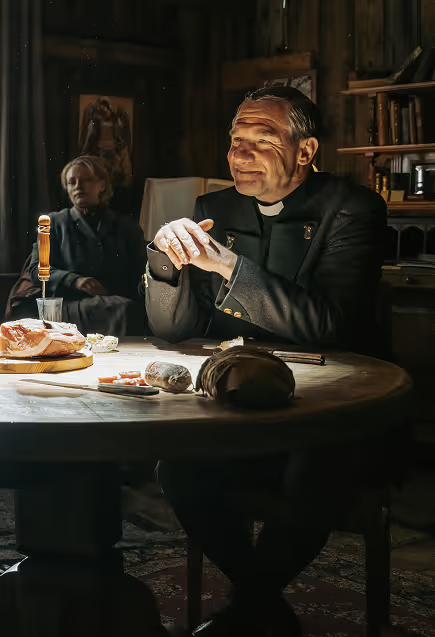
Johannes Zeiler grew up in the eastern part of Styria in Austria. He studied acting at the Max Reinhardt-Seminar in Vienna. Upon graduation, he began to work extensively in theatre, firstly as a member of Peter Stein’s Faust ensemble, followed by several years at the Schauspielhaus in Vienna. His screen credits include the lead role in Alexander Sokurov’s film adaptation of Faust, which premiered at the 68th Film Festival in Venice and won the Golden Lion. He played the lead in Detlev Buck’s adaption of Daniel Kehlmann’s bestselling novel Measuring the world, in October November by Oscar nominated director Götz Spielmann, and the lead role in the Austrian TV series Cop Stories.
His recent work includes the role of ‘Michalski’ in Sven Unterwaldt’s comedy Help, I shrunk my teacher and its sequel, as well as the lead role in the feature film Wackersdorf. Furthermore, Johannes played the recurring role of ‘Stefan Fazius’ in Netflix’s The Last Word. He is perhaps best known to international audiences for playing ‘Uwe Rossler’ opposite Helen Hunt in the BBC Drama Series World On Fire.
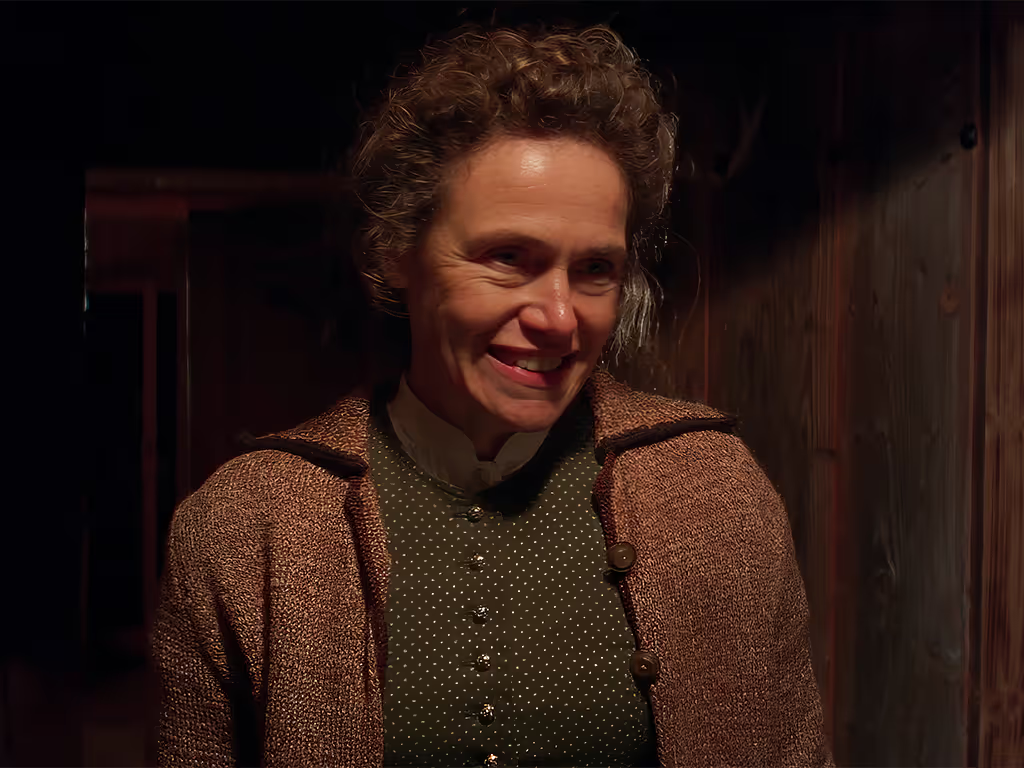
Gonny Gaakeer was born in Leeuwarden, the Netherlands, and studied at the Toneelacademie Maastricht. As an actress and theater maker, she has performed extensively in German, Frisian, and English. She can be seen on SKY/Peacock since May 2, 2024, as Naomi Hoffmanova in the UK series The Tattooist of Auschwitz, based on Heather Morris's book.
Gaakeer wrote and performs a monologue about Marie Stoppelman, a Jewish Dutch doctor who was forced to work for Josef Mengele in order to survive Auschwitz.
A selection of films and series in which she has appeared includes: De Joodse Raad, De Ring, BuZa 2, Het Verloren Transport, Moffenmeid, All Stars, Nynke, and the German productions Block 10 (2026), Mord mit Aussicht, and Rentnercops.
- Harald SwinkelsWRITER | DIRECTOR | PRODUCER
- Rianne BeenesPRODUCER
- Indra BaarsHead of Production
- Kim IdzerdaHead of Production
- Chiara TRERÈLocal Producer Italy
- Marnie BlokExecutive Producer
- Johan DijkstraDIRECTOR OF PHOTOGRAPHY
- Caroline BevaartASSISTANT DIRECTOR | co-writer
- Ivonne Verbeek1st AD
- Florian LegtersPRODUCTION DESIGNER
- Suzanne ElderingHEAD WARDROBE
- Jacqueline HoogendijkHEAD HAIR & MAKEUP
- Elisabeth HesemansCHILD MENTOR | PLAY COACH
- Marina WijnCASTING DIRECTOR
- Bob TholeMUSIC PRODUCER | COMPOSER
- Vincent WitteSOUND DESIGNER | RE-RECORDING MIXER
- Debora ScaperottaLOCATION MANAGER
- Pablo Navarro-RubioVFX SUPERVISOR
- Berta BanaclocheCLAPPER | LOADER
- Brian KrijgsmanDIGITAL INTERMEDIATE COLORIST
- Kevin WhelanEDITOR

“From the beginning, Harald and I envisioned Odessa as a period hero’s journey set against the breathtaking yet ominous Dolomites, aiming for a visceral 1940s look—naturalistic, not overstylized. Shooting on 35mm gave us the grain, texture, and color we wanted without digital interference.
We used Kodak 50D and 250D for exteriors, 500T for interiors, overexposing by 1–2 stops to retain detail and texture. Daylight-lit 500T preserved cool undertones. Paired with Atlas Orion 2x anamorphic lenses, the look balanced modern functionality with vintage imperfections.
The 40mm lens was our primary choice, subtly favoring Josef to draw viewers into his perspective. Inspired by Linus Sandgren’s Babylon, we tested the Orions extensively with the Arricam LT to ensure they matched the film’s tone.
By combining S35 film with the raw Dolomites, we crafted a visual style that mirrors the story’s emotional and environmental duality.”
— Johan Dijkstra, Director of Photography
"From the very beginning, already during the script-writing phase,director Harald Swinkels envisioned the haunting sound of the Carnyx horn echoing throughout Odessa—and he gave me a bold challenge: to compose the entire score using only this ancient war horn.
With no prior experience working with the instrument, we embarked on an eight-hour recording session, capturing a wide range of tones and textures to create a unique sonic palette. Surprisingly, many of the most unconventional sounds—the eerie distortions and raw resonances—became instrumental in shaping the film’s intense chase sequence.
What makes the Carnyx extraordinary is its duality: it conveys deep, emotional gravitas while also producing visceral, primal energy. The final score was composed entirely on this unique instrument, adding a powerful, otherworldly dimension to Odessa."
"Odessa was a sonic playground, and for this project we wantedto push cinema sound to its full potential. Harald envisioned animmersive audio experience that would make the audience feellike they were really there.
Given the stunning locations, we sought a way to capture their unique acoustics. To achieve this, we used ambisonic impulse responses - capturing the real acoustics of a location and applying them to sound effects in post. We recorded an alarm pistol echoing through the mountains essentially taking a 3D snapshot of the reverb (echo) of a specific location in the Dolomites, rather than relying on artificial reverb.
The result is an eerie, authentic resonance. Striking examples include the chilling echoes of the Carnyx horn and the moment when Frau Scholl screams her alarm. By grounding the sound design in the actual acoustics of the Odessa landscapes, we enhanced the film’s sense of place and atmosphere, making the audience feel as if they were really in the Dolomites with Josef and his family."
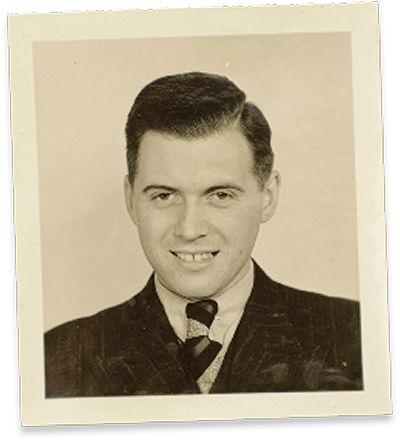
Known as the “Angel of Death,” Josef Mengele was one of the most notorious Nazi doctors. He conducted brutal medical experiments on prisoners - most notably on twins - at the death camp Auschwitz-Birkenau. After the war, he successfully fled over the Italian Dolomites to South America and died of a stroke while swimming in Brazil in 1979.

Irene Schönbein became the first wife of Josef Mengele, marrying him in 1939. As Josef evaded capture after World War II, Irene refused to join him in exile, expressing a desire for a “normal, open life” away from the shadows of his crimes. She passed away in 1977.

Rolf Mengele was born in 1944. He grew up largely separated from his father. As an adult, he confronted Josef with his crimes during a visit to Brazil, but later admitted to a deep inner conflict: “I would never betray my father. No one in the world can ask me to do that.”

An acronym for Organisation der ehemaligen SS-Angehörigen (Organization of former SS members),O.D.E.S.S.A. is a rumored secret network that allegedly helped high-ranking Nazis escape justice after WorldWar II. Known among insiders as “Die Spinnen”, the organization is believed to have helped them flee to South America.